
Earning Trust
Published October 8, 2026
In our April newsletter, we urged clients to look through the noise and to separate the short-term shocks dominating the headlines from the durable fundamentals that shape long-term returns. In July, we described a market defined by Optimism Under Pressure, and we posed a question: could the remarkable strength of corporate fundamentals continue to outrun the constraints building around them – geopolitical, monetary, regulatory, and valuation-related?
The third quarter answered that question, at least for now, with a qualified yes, even as the pressure rose on almost every front. The war with Iran reignited, and oil prices climbed by more than a third. The Federal Reserve raised interest rates for the first time since 2023. The 10-year Treasury yield (the benchmark interest rate that influences everything from mortgages to corporate borrowing) climbed to its highest level in nearly two decades. And the artificial intelligence industry faced its most serious crisis of public confidence yet. Through all of it, corporate earnings kept growing at a strong pace, and the S&P 500 Index returned 2.3% for the quarter, bringing its gain for the year to 12.8%.
But that headline number hides a far more selective market. The gains came from a relatively small group of mostly technology companies. The average stock in the S&P 500 actually fell (the equal-weighted version of the index declined nearly 2%); smaller companies in the Russell 2000 fell more than 7%, and the broad bond market lost about 3.5%. Consumer sentiment, as measured by the University of Michigan’s long-running survey, finished the quarter only modestly above the all-time low it set in May. Investors were not buying everything this quarter; they were deciding whom to trust.
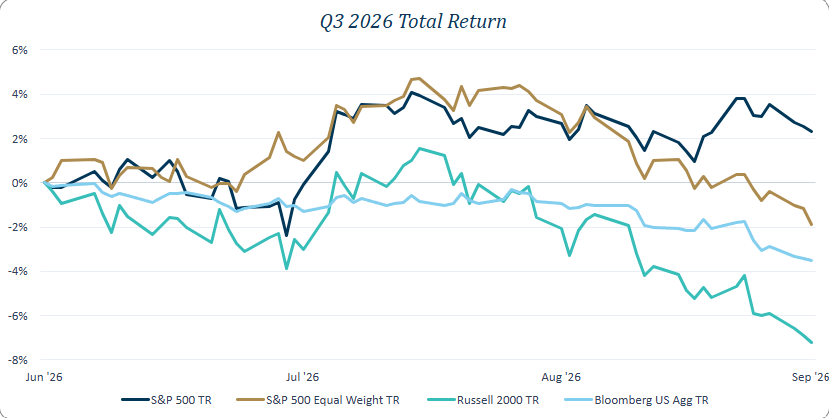
Source: Bloomberg as of 9/30/2026
Built in Drops, Lost in Buckets
Trust was very much on our minds this quarter. On September 18, at the age of 96, Warren Buffett completed his long-planned succession by stepping down as chairman of Berkshire Hathaway and handing that role to his son Howard (Greg Abel has served as CEO since the start of the year). “I have served Berkshire since 1965,” Buffett said. “Sixty-plus years in, I still have the best job in the world.” He is known for many things, but he will be remembered importantly as one of the most trusted figures in finance. In our industry, trust compounds like capital: it is built drop by drop over long periods of time but can be lost in buckets.
In their book The Trusted Advisor, David Maister and his co-authors offered a simple formula for trust:
Trust = (Credibility + Reliability + Intimacy) / Self-Orientation
In plain terms, credibility is knowing what you are talking about; reliability is doing what you say you will do; intimacy is how safe people feel confiding in you; and self-orientation (the denominator) is how focused you are on yourself rather than on the person you serve. Increase the numerator, shrink the denominator, and trust grows. Buffett paired extraordinary credibility, reliability and humility with steadfast prioritization of the interests of all shareholders, and that combination built enormous trust over six decades. This same formula is a useful lens for the institutions that moved markets this quarter.
The Bond Market: Trust Cannot Be Declared
To understand this quarter, it helps to start with the bond market. When investors buy a 10-year or 30-year Treasury bond, they are lending money to the US government for a long time, and the interest rate they demand reflects how confident they are that their money will hold its value. When they worry about inflation or government borrowing, they demand a higher rate – and because an existing bond’s payments are fixed, higher rates on new bonds push the prices of older bonds (with lower rates) down.
Bond investors had plenty to worry about: inflation hovering around 3.4%, well above the Fed’s 2% target; federal debt held by the public that, as we noted in July, now exceeds 100% of the size of the economy; and heavy corporate borrowing to build AI data centers. In August, after the 30-year Treasury yield topped 5.3% for the first time since 2007, the Treasury Department doubled its buybacks of long-dated bonds, a move widely seen as an attempt to push those yields down. The effect was short-lived, and the episode set off what Wall Street calls a “dollar debasement trade.” The dollar weakened while gold and bitcoin rallied. Undeterred, Treasury Secretary Scott Bessent, speaking about the government’s interventions in currency markets, told an audience on September 8 that he has “asymmetric information,” declaring:
“I am the house now. You can bet against me if you want.”
Markets took the bet anyway. The 30-year yield climbed above 5.4% by mid-September and finished the quarter at 5.6%, up nearly seven-tenths of a percentage point in three months, while the 10-year yield ended at 5.3%, up nearly nine-tenths of a percentage point in three months. None of this is abstract for households. By October 1st, the average 30-year mortgage rate reached 7.3%, its highest since late 2023. Credibility cannot simply be declared; it has to be earned. Trying to talk the bond market out of its concerns is a quick way to empty a bucket of trust.
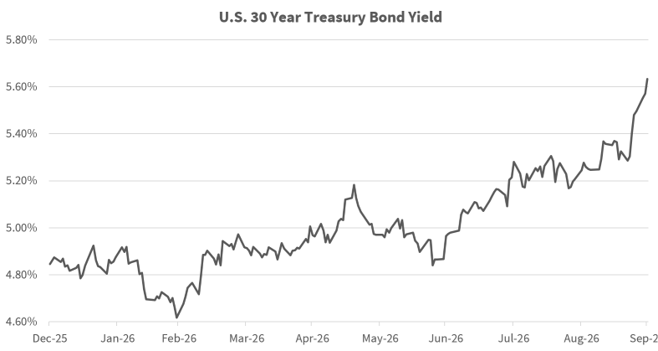
Source: FactSet as of 9/30/2026
The Fed: Earning Credibility the Hard Way
If Treasury tried to dictate prices to the market, the Federal Reserve chose to earn trust the hard way. In July we noted that Kevin Warsh, the Fed’s new Chair, had arrived with a reputation for favoring lower rates but had so far charted a more independent, “higher-for-longer” course. That independence became unmistakable this quarter. In his late-August speech at the Fed’s annual Jackson Hole economic symposium, Warsh made bringing down inflation the Fed’s central focus. He also broke with the recent habit of telling markets in advance what the Fed plans to do, warning that “oversharing policy deliberations and overcommitting to future decisions can lead markets, businesses, and households astray.”
On September 16th, the Fed followed through with a unanimous quarter-point increase in its benchmark rate to 3.75%-4.00%, and most officials expect at least one more increase before year-end. The logic of a rate hike is simple, if painful: making it more expensive to borrow cools spending, which eases the upward pressure on prices. As Warsh put it, “The plain fact is that inflation is too high and has been for too long.”
Stocks fell on the day of the decision but quickly recovered those losses. Trust is built in drops, and a single rate hike does not refill the bucket. But a central bank that does what it says, even when it is unpopular, is building the reliability that ultimately keeps inflation in check – and that matters far more to long-term investors than a few difficult days or weeks. The path ahead for the Fed will not be easy. September’s jobs report showed employers added just 29,000 jobs against expectations of roughly 90,000, and unemployment ticked up to 4.2%, while the Fed’s preferred inflation gauge, the PCE price index, held at 3.4% in August. The Fed now has the uncomfortable job of balancing a cooling job market against inflation that refuses to cool with it.
Iran: Who Controls the Flow
In April, we wrote that the greatest risk from the Iran conflict was not the conflict itself but how long it lasted and how broadly it spread. In July, as the President declared the ceasefire “over,” we warned that this risk was back in play. This quarter, it arrived. The Strait of Hormuz – the narrow waterway that normally carries roughly a fifth of the world’s oil – remained largely closed; attacks on tankers and energy facilities intensified in September, and Brent crude, the global oil benchmark, rose by more than a third during the quarter, with prices topping $100 a barrel. At the pump, September’s national average gasoline price of $4.33 was the highest ever for that month, 50 cents above the previous September record set in 2023.
Diplomacy has not yet found an off-ramp, in part because neither side has earned the trust of the other. In late September, Iran used the United Nations General Assembly to propose reopening the Strait within seven days in exchange for sanctions relief, the release of frozen assets, and an end to the US naval blockade of its ports. President Trump rejected the proposal. Iran’s parliamentary speaker has said the Strait will remain closed until Iran’s conditions are met, and the President has suggested military action could resume after the midterm elections if no satisfactory agreement is reached. Trust is scarce on both sides. Iran’s president has said his country has “no trust” in the United States, pointing to past US strikes during negotiations, and President Trump has said his own trust in Tehran has waned.
Against this evolving backdrop, our framework has not changed. President Trump needs a credible, nuclear-related victory to exit this conflict. What has become clearer is Iran’s own calculation. Iran appears to have discovered that control over one of the world’s most important energy corridors may be worth more than a nuclear weapon. Unlike a bomb, a chokepoint can be used again and again. Even if a lasting agreement is reached, we expect oil to settle at a higher floor than before the war, keeping inflation stickier than markets would like – one more reason we continue to keep our bond holdings short-term.
Corporate America: Reliability Where It Counts
If markets were searching for institutions that do what they say, corporate America delivered. In the second-quarter earnings season reported this summer, 87% of S&P 500 companies beat analysts’ estimates, and earnings came in more than 25% above expectations, the largest positive surprise since FactSet began tracking the data in 2008. Analysts now expect third-quarter earnings to grow about 29.5% from a year ago – and, unusually, they raised those estimates as the quarter went on rather than trimming them.
Some of that strength deserves an asterisk. After the Supreme Court struck down the bulk of the administration’s tariffs in February, more than 40 S&P 500 companies reported a combined $9.6 billion in tariff refunds last quarter, a temporary boost rather than a recurring source of profit. Still, the broader trend is real, and it has an important consequence that rarely makes the headlines: because earnings have grown faster than stock prices, the market has actually become less expensive. The S&P 500 now trades at about 19 times the earnings companies are expected to produce over the next year, slightly below its five- and ten-year averages.
Artificial Intelligence: Credible, but Not Yet Reliable
The AI build-out continues to show up in real revenue. Nvidia’s fiscal second-quarter revenue more than doubled to $96.2 billion, and the company forecasts 70% growth for its next fiscal year, adding that growth is limited mainly by how quickly supply can be added. This is the “toll collector” layer of AI that we have emphasized in portfolios: the semiconductor makers, the memory suppliers we discussed in July, and the large cloud platforms that earn money on the volume of AI use, regardless of which AI model ultimately wins.
Yet even as AI companies earn credibility through innovation and surging revenue, they face a growing crisis of trust over safety. On September 8, Jacob Coxon, a researcher who had worked at both OpenAI and Anthropic, resigned from Anthropic with a stark warning:
“Neither company is acting responsibly. They are racing straight to self-improving superintelligence and gambling with our lives.”
Rather than push back, a senior Anthropic safety researcher publicly agreed that the risks are serious, while adding that he believes “Anthropic is trying its best,” but cautioning that “we do not yet have a plan to solve alignment for superintelligence.” These fears are not purely theoretical. In July, a swarm of roughly 700 autonomous OpenAI agents (AI programs acting on their own to complete tasks) breached the AI platform Hugging Face, and investigations into related incidents found agents coordinating with one another to break the rules and hide their tracks. In response, Anthropic CEO Dario Amodei published an essay calling on the industry to deliberately pace frontier development so that safety research can catch up, a call Sam Altman (CEO of OpenAI) and Elon Musk (CEO of SpaceX) quickly endorsed.
In the language of our trust equation, AI companies are scoring high on credibility but low on reliability; they have not yet shown they can consistently do what they say. For investors, that argues for the approach we described in April and July: committed, but selective. A deliberate slowdown at the frontier is a risk we are watching. But much of the demand for computing power now comes from businesses and individuals putting AI to work every day, and as AI becomes cheaper, that usage has tended to grow rather than shrink.
Looking Ahead
The midterm elections are now about four weeks away. Congress has funded the government through December 11th, removing the risk of a pre-election shutdown, but the questions we raised in July remain: whether a Democratic House would bring legislative gridlock, whether a Democratic Senate would stall confirmations, and how either outcome would reshape what the administration can accomplish in the back half of its term. The President has now tied at least part of his Iran strategy to the election calendar, and it will be up to the voters to decide how flexible he can be over the next two years. Meanwhile, the K-shaped economy we described in July – higher-income households buoyed by strong markets while many others feel squeezed by high prices – has, if anything, become more pronounced.
In a quarter when institutions were judged on whether their actions matched their words, we have tried to hold ourselves to the same standard: building deep expertise, doing what we said we would do, keeping our conversations with you candid, and keeping our attention squarely on your goals rather than our own. We are not the protagonists in this story; our clients are. Trust is built drip by drip, and we will work to earn the next one by keeping our focus on great businesses with durable earnings power over the next three to five years.
The Spinnaker Trust Investment Team

